
Reviews
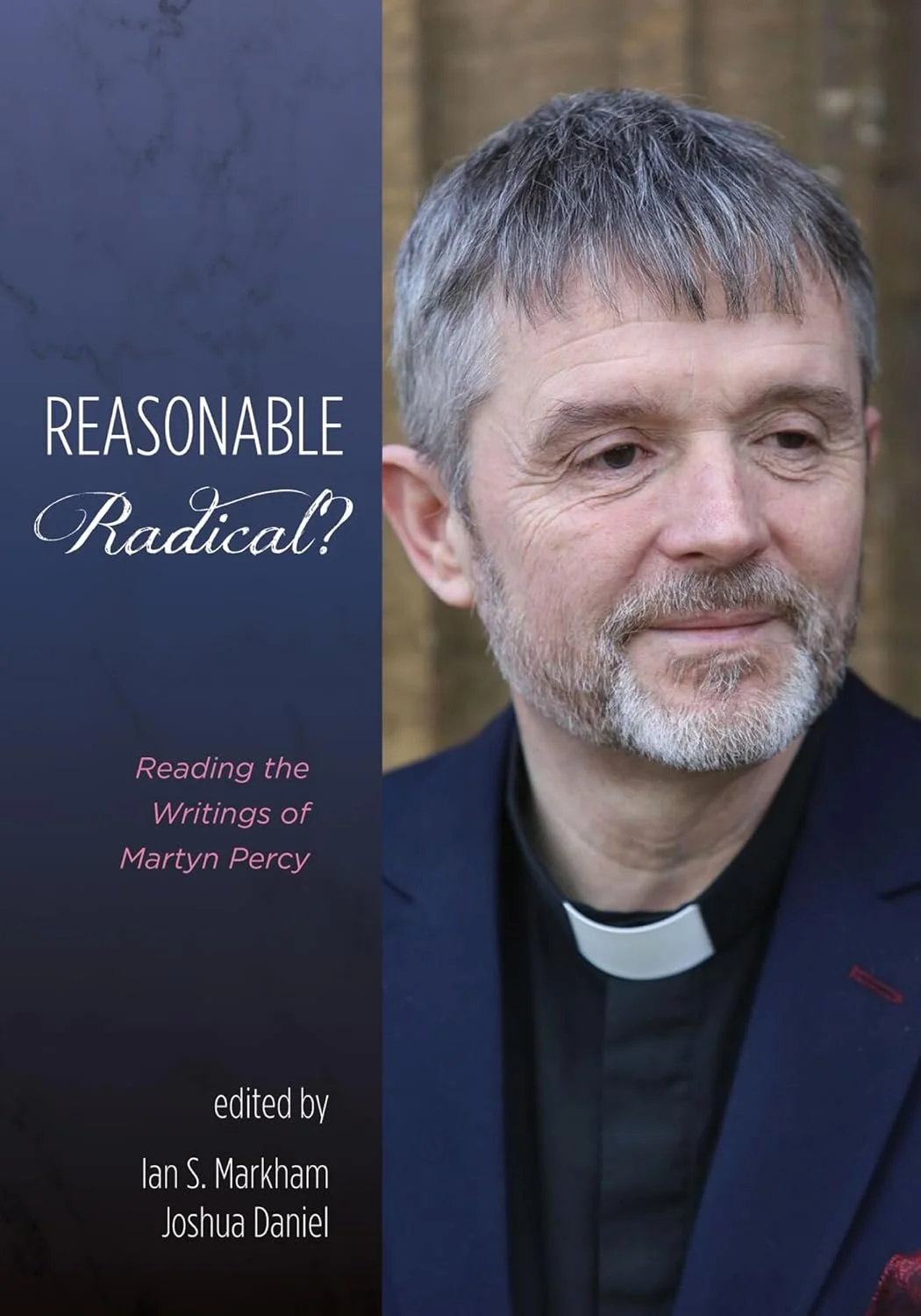
Reasonable Radical? Reading the Writings of Martyn Percy, Pickwick Publications/Wipf & Stock, 2018: edited by Ian Markham and Joshua Daniels, p. xii):
“We need the theologian who is well-versed in the tradition but can connect with the Church as it really is. Percy is a “contextual theologian” or even, perhaps, a “practical theologian”. With the contextual theologians, Percy believes that context is both important as theological ideas emerge (so even with the Trinity at Nicaea) and for the application of theological ideas in different situations. One of the most striking areas of originality in Martyn’s work is his method. He is a latter-day essayist – unusual amongst contemporary academics, but part of a classic tradition. The medium is perfect for his message: the two are inseparable. Martyn does theology, sociology and anthropology not from the vantage point of the preacher in the pulpit or the academic in the ivory tower, but from within the communities of practice he is addressing - church, society and academy.
Martyn realises that truth and language are always situated, contextual. He believes that the writer should give as well as take, and that responsible scholarship is about call and answer. The method is perfectly adapted to the kind of ethnography he is skilled at, and to the Anglican tradition to which he belongs - in which lived practice has always been more important than abstract reflection or doctrinal definition. Martyn has crafted a medium which is perfectly adapted to his message, indeed it is his message.”
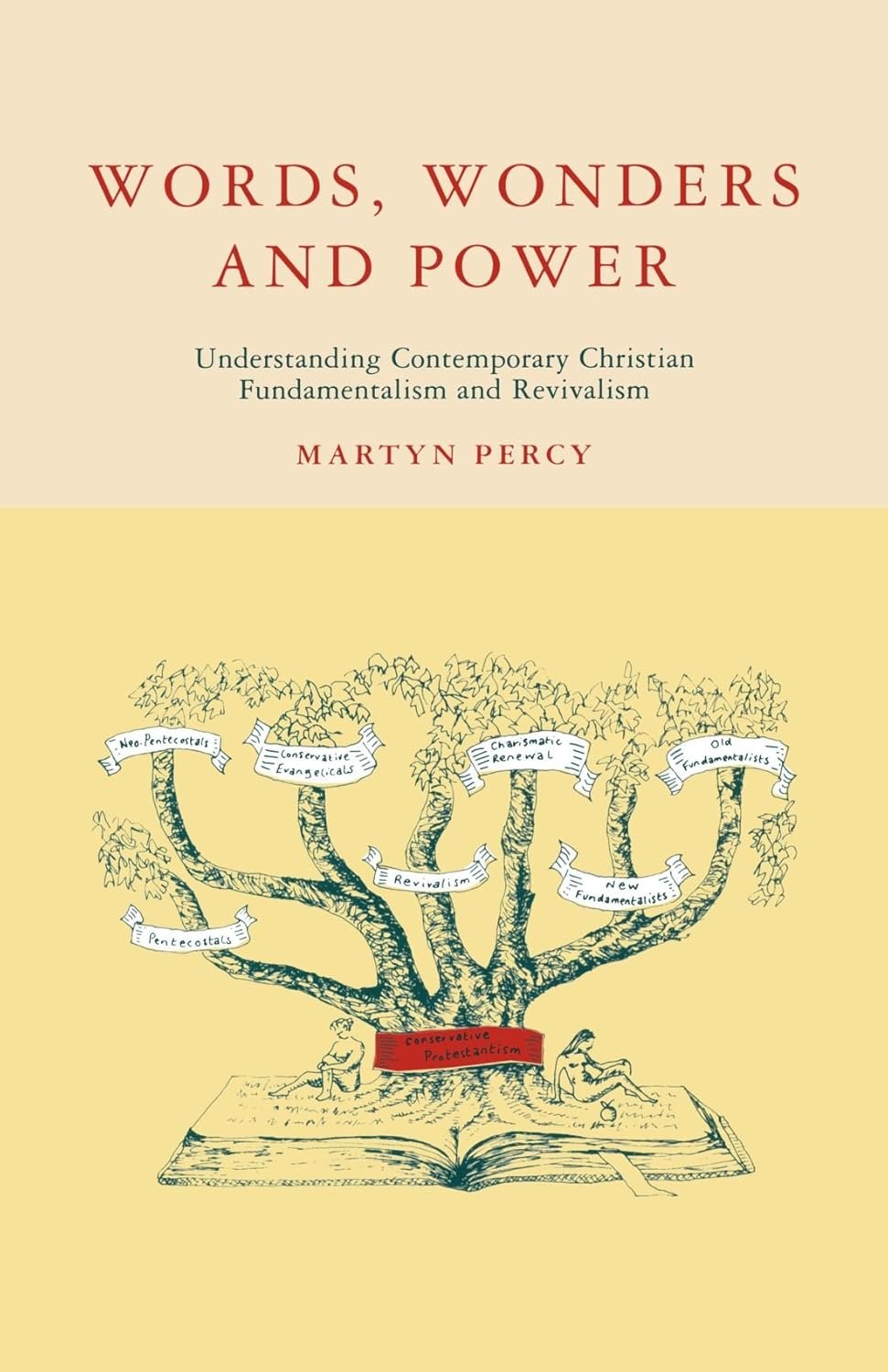
Words, Wonders and Powers: Understanding Contemporary Christian Fundamentalism and Revivalism, 1995
This book has been on my radar and on my bookshelves for a number of years. Written over twenty years ago, back when I was six and the Third-wave charismatic movement (of which I am now theologically a part) was grappling with the onrushing tide of the so-called Toronto Blessing. And Martyn Percy, now a leading light in Anglican liberalism, was writing this book, ‘Words, Wonders and Power: Understanding Contemporary Christian Fundamentalism and Revivalism’. I say all this by way of context – I am late to the party, according to some, and certainly late to the reviewing of this book – and to set up this review for what it is (A review of book twenty years after publication) and not what it is not (whatever you might be thinking).
Percy writes this book as a theologian, seeking to explain a theological phenomenon. As someone who has personally moved from a cessationist evangelicalism to a charismatic evangelicalism, I’m reasonably well rehearsed around the discussions and debates on that spectrum. As I’ve studied theology, been married a bit longer, changed churches and cities, and become exposed to more, I’m gradually realising that there is a wide ocean of responses to the Charismatic movement, from various angles within and without the Church. This book is one from within the Church, informed by Anglicanism but not beholden to it, and open to genuine and careful investigation of charismatic phenomena.
I read this book because, as part of my 2017 Reading Challenge I’m keen to read widely and broadly, and this is a book I should have read long ago. This is a book from a critical but careful outsider – a model in how to explore something you disagree with without condemning it. This book has some helpful and ever-relevant reflections on charismatic practice and ecclesial power. Overall, this book is a key part of the growing corpus of literature on the Vineyard/Revival movements from a theological perspective, and bears reading. Tom Creedy.
Engaging with Contemporary Culture: Christianity, Theology and the Concrete Church, 2005
'One reason why this book by Martyn Percy is worth reading is that it asks the sorts of questions that others sometimes avoid. He is happy to accept the ambiguities with which we live, regarding post-modernity as 'more of a mood' than anything else, and is not afraid to challenge the hegemony of trendy movement such as Radical Orthodoxy (described as 'pushy theological bullying').' The book is worthwhile for those who wish to consider varied aspects of the contemporary Church as it engages with the wider culture and as it reflects or is shaped by that culture as well as when it resists that culture and its messages and values.' Church Times
'I commend Martyn Percy's new book to Anglican and Catholic laity, pastors, theologians, and bishops. All, with his sprightly prose drawing them in, will find themselves joining his search for authentic paths for Christian faith. All will also find something to disagree with. Percy's well-researched work is not a polite chat about how we can all get along better. His practical theology examines lived faith and ordinary life, where Christianity and culture meet.' Thomas Hughson, SJ, Marquette University, Milwaukee, USA
'Martyn Percy has provided an insightful and fresh approach to the dialogue between theology, church and world. He achieves this through a series of penetrating theological sketches touching the everyday life of churches and western culture. The accent is on engagement, the theology is practical and grounded. The result is an intellectually robust, accessible and provocative public theology. He shows himself to be a theologian at the cutting edge of contemporary Christian Theology. A joy to read and plenty of food for further engagement.' Stephen Pickard, School of Theology, Charles Sturt University, Australia

Anglicanism: Confidence, Commitment, and Communion, 2015
This work on Anglicanism is part of the Ashgate Contemporary Ecclesiology series. The author, Martyn Percy, from Ripon College Cuddesdon in Oxford, UK, is one of the series’ editors. The chapters comprising this book began as lectures or articles, most of which have been published elsewhere. They contain reflections on Anglican identity, mission, and ministry that are primarily rooted in the Church of England. As the heart of Anglicanism, happenings and writings from the Church of England will always carry a certain weight for the worldwide Anglican Communion (which is the largest Protestant fellowship in the world). However, the relevance of this book for the Anglican Church (and emerging Anglican movement) in the United States is limited by the narrow focus of the book. It is not that one cannot gain important and transferable insights. In fact, the book is full of scholarly analysis and penetrating insight. Much of it is beautifully written, and there is genuine Christian wisdom found throughout.
Percy believes that his reflections, informed by approximately ten years of life at Cuddesdon, can “offer insight and illumination, and highlight how rich and reflexive the Anglican tradition can be in preaching and proclaiming Christ” (p. 6). This kind of example may prove necessary in light of current struggles in the Anglican Church. “Debates on sexuality and gender (women bishops), whether the church has a Covenant, or can be a Communion, how it is ultimately led, are issues that have dominated the ecclesial horizon for several decades now” (p. 6).
Percy’s approach in this study is “binocular” in that he synthesizes a theological approach with a sociological/anthropological approach. This method serves the study well and brings weight to his analysis. But since most of the research is based upon figures in the UK, it is most applicable to that context. One will find similar situations in the US, but a reader will have to work out those applications on their own because they are not directly addressed in the book. Only one chapter significantly addresses the Anglican situation in America. I will address it below.
In this short space I will comment on just two chapters that I find to be of particular interest. The first is a chapter in part two titled, “Old Tricks for New Dogs: A Critique of Fresh Expressions.” Fresh Expressions is a movement that “encourages and resources new ways of being church, working with Christians from a broad range of denominations and traditions. The movement has resulted in thousands of new congregations being formed alongside more traditional churches” (see http://www.freshexpressions.org.uk/). These church-like gatherings aim at impacting the society by being culturally relevant. However, Percy suggests that the movement is “a form of collusion with contemporary cultural obsession with newness, alternatives and novelty, rather than the recovery of a lost theological, missiological or ecclesiological priority” (p. 123). And again, “the Fresh Expressions movement may represent a conservative, therapeutic and individualist retreat from the world, whilst cloaked in a rhetoric that emphasises the very opposite of this: namely ‘cutting edge’, ‘radical’ and so forth” (p. 127).
Percy is concerned that these sorts of fellowships, disconnected from the historic Church of England (or any other historic denomination), are too connected to consumerists’ impulses. With regard to the new forms of church that are emerging he comments, “new is not necessarily better than old; fresh is not necessarily superior to established; and effervescence is not a substitute for substance . . . innovation should be judged by tradition” (p. 130). Then he adds, in a pithy line, “‘emerging church’ is not likely to be superior to the emerged church” (p. 130). This is a great line. This is also a great chapter worthy of our consideration. Many feel the challenge of cultural relevance. But how might the church engage society without losing the historic treasures she has to offer? Percy’s critique is timely and astute. His work proves helpful on this subject.
For Percy, “Anglicanism is mostly a temperate ecclesial body” (p. 157), that “catholicity” must be preserved, and the church must “live with difference and diversity” (p. 158). In a later chapter Percy advances a related notion, “In ecclesiological terms, if you have the choice between heresy and schism, choose heresy. You can correct the former; but it will always be difficult to ever heal the latter” (p. 177). For Percy, this is a typically Anglican way of handling issues. Great patience, discussion, diversity, politeness, and wide reach should all be valued above particular stances on culturally-conditioned disputes (as he understands the sexuality debate).
Percy’s book deserves to be read for its mature and (in many ways) compelling insights. Readers will learn a lot and be driven to contemplation by a generally winsome voice. The book is especially valuable to those in the Church of England who desire to better understand, and be challenged, in their own context. One might forgive the author for not fully grasping Anglican issues in the US. And even if one is inclined to take hard theological positions on current disputes, Percy’s commendation of the spirit of Anglicanism as “passionate coolness” (Robert Runcie) is worthy of our consideration. No church should be quick to move to schism. But this is sometimes necessary if the very foundations of the house are beginning to crumble.
Jonathan Huggins, Themelios
The Crisis of Colonial Anglicanism, 2025'
I recently spent time with The Crisis of Colonial Anglicanism…it is a work that carries strong intellectual weight, contemporary relevance… What stands out immediately is the clarity of the central argument. This is not a neutral historical account. It is a critical examination of how English Anglicanism positioned itself within the machinery of Empire, and how that positioning shaped both religious identity and global perception.
The framing of Anglicanism as a “lead character” within its own constructed narrative is particularly effective. It highlights how institutions can internalise their own mythology, reinforcing authority while obscuring the realities that supported it. That idea of “serious fiction” introduces a conceptual lens that carries throughout the work. What gives the book its depth is the connection between theology and power. The argument does not isolate religious practice from political and economic structures. Instead, it shows how they operate together, reinforcing hierarchies built on exploitation, classism, and racial assumptions.
The discussion of historical amnesia is also central. It shifts the focus from what happened to how it has been remembered, or deliberately not remembered. That perspective reframes the conversation, positioning the present not as separate from the past, but as shaped by the selective interpretation of it. The global dimension further strengthens the argument. By examining how formerly colonised societies have responded, resisted, and redefined their place, the book moves beyond critique into consequence. It shows how the assumptions embedded in imperial structures have led to a gradual erosion of influence and authority.
What [also] gives the work its relevance is the idea of moral reckoning. The challenges facing the Anglican Communion are not presented as isolated issues, but as part of a longer historical trajectory that is now reaching a point of confrontation. At 368 pages, the book has the space to develop these arguments with depth, connecting historical analysis with contemporary implications in a way that invites reflection rather than simple agreement or disagreement. What makes this book particularly compelling is its perspective. It does not repeat familiar narratives. That’s what makes this work. Elisabeth Gloria.
